
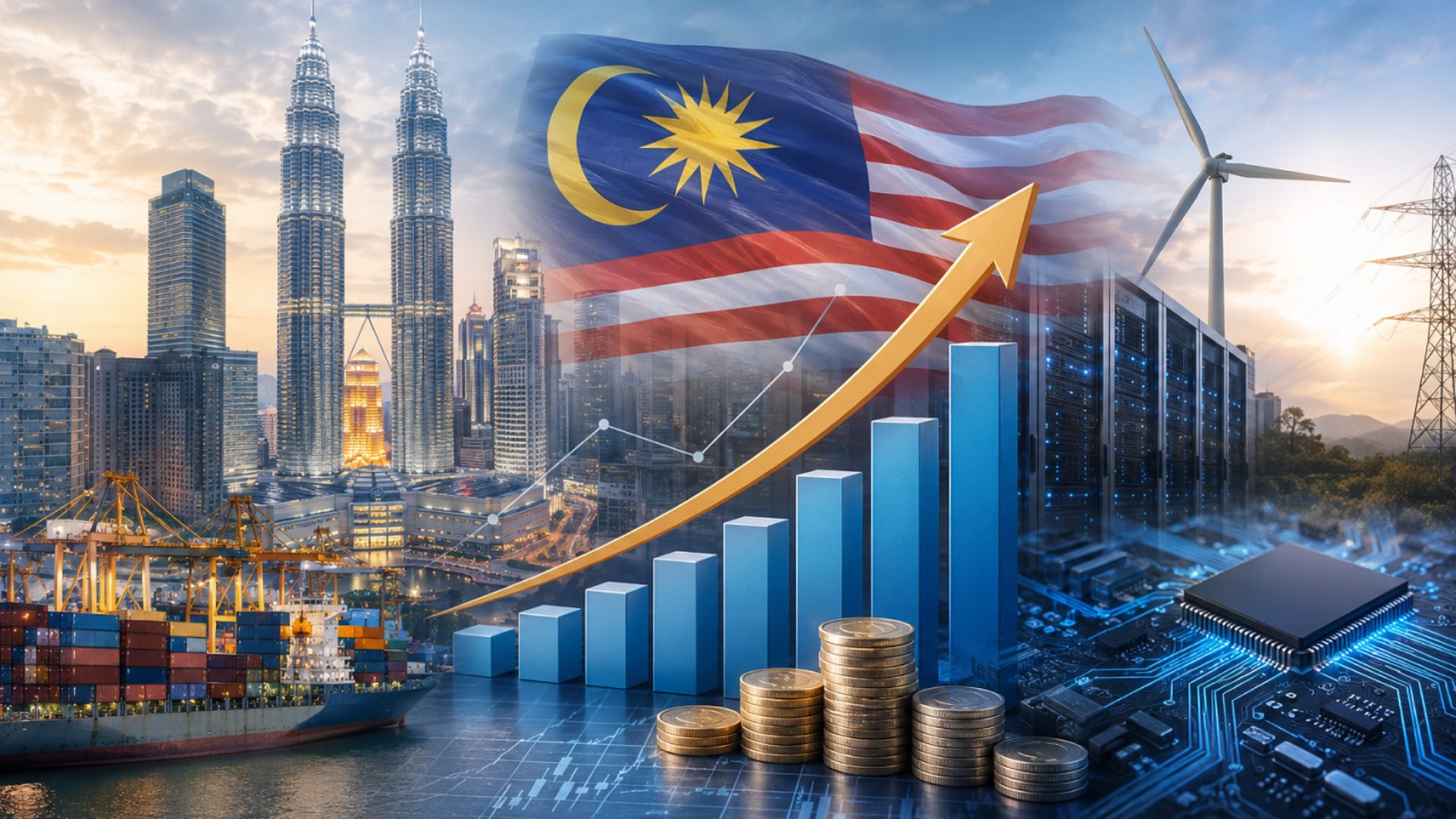
Malaysia’s economy expanded by 6.0% in the second quarter of 2026, accelerating from 5.4% in the first quarter, according to Bank Negara Malaysia’s latest assessment of economic and financial developments. On a quarter-on-quarter seasonally adjusted basis, the economy grew by 2.5%, a significant improvement from the near-flat performance recorded in Q1. While the headline figure is encouraging, the more important question for investors is not simply how quickly Malaysia is growing, but what is driving that growth, how sustainable it is, and whether the current economic environment is creating a stronger platform for future investment.
The Q2 performance was supported by a relatively broad range of economic activities. Household spending remained resilient, supported by steady income growth and ongoing policy measures, while investment continued to expand, particularly through spending on structures and machinery and equipment. External trade also strengthened, with exports benefiting from continued demand for electrical and electronics (E&E) products, sustained expansion in services, as well as a rebound in liquefied natural gas (LNG) and non-E&E manufacturing exports. Imports also expanded, particularly intermediate and consumer goods, consistent with stronger economic activity. Taken together, these developments point to an economy where domestic consumption, investment and external demand are contributing simultaneously to growth.
For investors, however, the composition of growth is arguably more important than the headline number itself. One of the clearest signals from the Q2 data is the growing importance of technology-related activity. The services sector continued to benefit from business-related activities, particularly information and communication technology (ICT), as the operationalisation of data centres expanded. At the same time, manufacturing growth was supported by export-oriented industries, particularly E&E, amid strong demand associated with artificial intelligence (AI). These developments place Malaysia within several structural trends that are reshaping global investment flows.
The connection between these sectors is particularly important. The expansion of AI requires greater computing capacity, which in turn increases demand for data centres, semiconductors, electricity, connectivity, engineering and specialised infrastructure. Data-centre investment can also generate demand for construction, energy, telecommunications, cooling systems, cybersecurity and professional services. Malaysia therefore has an opportunity to participate in the AI economy across multiple layers of the value chain rather than through a single industry.
The more important question is whether Malaysia can deepen these linkages. A major data-centre project, for example, may involve significant capital expenditure, but its long-term economic contribution will depend on how much of the surrounding value chain can be developed domestically. Can Malaysian engineering and construction companies participate meaningfully in the supply chain? Can local technology firms provide supporting services? Can these investments create specialised employment and facilitate knowledge transfer? And can Malaysia develop the infrastructure and talent required to support the next generation of projects?
The same principle applies to semiconductor and advanced manufacturing investments. The headline value of an investment remains important, but the quality of its domestic spillovers may ultimately be more consequential. An investment that develops local suppliers, creates higher-skilled employment, facilitates technology transfer and raises productivity across the wider economy can generate substantially greater long-term value than one that operates largely as an isolated production facility.
This is where Malaysia’s investment discussion needs to evolve. Attracting capital is important, but attracting capital should not be the end objective. The more strategic question is how effectively Malaysia can embed investment within the domestic economy and convert it into stronger productive capacity.
The macroeconomic environment also provides a relatively supportive backdrop. Headline inflation increased from 1.6% in Q1 to 1.9% in Q2, largely reflecting higher external cost pressures, including movements in fuel prices. Fuel inflation rose to 5.0%, compared with -1.5% in the preceding quarter. However, core inflation moderated from 2.1% to 1.9%, suggesting that underlying domestic price pressures were not intensifying despite the increase in headline inflation. Inflation pervasiveness, measured by the share of Consumer Price Index items recording monthly price increases, stood at 45.5%, close to its historical average of 45.6%.
For investors, the distinction between headline and core inflation is important. The increase in overall inflation was influenced significantly by external cost pressures rather than a broad-based acceleration in domestic prices. Bank Negara Malaysia expects headline inflation to remain within 1.5% to 2.5% in 2026. A relatively contained inflation environment provides businesses with greater visibility over operating costs and consumers with more stable purchasing power, while reducing the risk that stronger economic activity develops into persistent domestic inflationary pressure.
Financial conditions are also supporting the expansion. Credit to the private non-financial sector grew by 6.4% in Q2, compared with 5.6% in Q1. Outstanding corporate bonds expanded by 8.1%, while outstanding business loans grew by 7.2%, reflecting financing for both working capital and investment-related purposes. SME loans grew by 4.2%, somewhat slower than the 5.2% recorded in Q1, but financing conditions overall remain supportive of economic activity.
This matters because the availability of financing can influence how quickly investment opportunities translate into actual economic activity. Investor confidence may create the willingness to invest, but businesses still require access to capital to expand capacity, purchase equipment, develop infrastructure and enter new markets. The stronger growth in corporate bonds and business loans therefore provides an additional indication that Malaysia’s financial system continues to accommodate the expansion of economic activity.
Currency conditions provide another important part of the investment equation. As of 12 August 2026, the Ringgit had depreciated by 0.9% against the US dollar year-to-date, while the nominal effective exchange rate had declined by approximately 1.0%. External factors, particularly changes in global financial conditions and expectations surrounding US monetary policy, will continue to influence the Ringgit. Nevertheless, Malaysia’s domestic fundamentals and continued economic growth provide an important source of support for the currency.
For international investors, currency stability does not eliminate foreign-exchange risk. It does, however, provide greater predictability when evaluating long-term capital commitments, operating costs and expected returns. This becomes particularly relevant for investments involving imported machinery and equipment, foreign-denominated financing or cross-border supply chains, where exchange-rate movements can materially affect project economics.
There are, of course, reasons to remain measured. Bank Negara Malaysia continues to project Malaysia’s 2026 GDP growth within the 4% to 5% range, although recent developments suggest that overall growth could be around 5%. The outlook remains exposed to geopolitical tensions, global trade developments, commodity prices and changes in monetary policy across major economies. Malaysia’s strong Q2 performance should therefore be viewed as a positive signal, rather than evidence that external risks have disappeared.
Nevertheless, the underlying outlook remains constructive. Household spending is expected to continue benefiting from income growth and policy measures, while investment should be supported by multi-year public and private projects, the continued realisation of approved investments and the implementation of national master plans. On the external front, sustained demand for E&E products, AI-related investment and global technology expansion should provide support, alongside tourism and the continued expansion of ICT services exports.
This brings us to a broader question for Malaysia’s investment strategy: what happens after the investment arrives?
For years, investment attraction has understandably focused on the size of capital commitments, the number of projects secured and the global companies establishing operations in Malaysia. These remain relevant indicators. However, as competition for international capital becomes more intense, the quality and economic depth of those investments will matter increasingly.
A RM10 billion investment commitment does not necessarily translate into RM10 billion of domestic economic value. The ultimate impact depends on the ecosystem surrounding the investment: how much expenditure is retained within the domestic economy, how many Malaysian companies participate in the supply chain, how much skilled employment is created, whether technology and expertise are transferred, and whether the investment contributes to higher productivity.
This is particularly relevant in sectors such as semiconductors, AI infrastructure, data centres, advanced manufacturing, renewable energy and digital services, where Malaysia is increasingly competing for large-scale international capital. These investments can generate significant economic spillovers, but such benefits do not occur automatically. They require strong domestic suppliers, specialised talent, reliable infrastructure, appropriate regulation and stronger connections between multinational investors and Malaysian businesses.
Malaysia’s investment strategy should therefore gradually evolve from attracting investment to embedding investment. The question should no longer be limited to how much capital is entering the country. It should also consider how much of the economic value generated by that capital Malaysia can retain, develop and build upon.
That means strengthening domestic supplier networks, developing specialised talent, encouraging technology transfer, improving local firms’ capabilities and ensuring that infrastructure keeps pace with the requirements of increasingly sophisticated industries. Done effectively, foreign investment becomes more than an inflow of capital. It becomes a mechanism for building domestic productive capacity and strengthening Malaysia’s long-term competitiveness.
This is equally relevant from the investor’s perspective. A market becomes more attractive when the ecosystem surrounding an investment is deep enough to support expansion, innovation and long-term competitiveness. Strong GDP growth may attract attention, but economic depth is what can sustain investment.
Malaysia’s 6.0% Q2 growth, moderate inflation, relatively stable currency, stronger credit expansion and continued investment activity provide a solid foundation. More importantly, the underlying drivers—particularly E&E, AI-related demand, data centres, ICT and advanced manufacturing—align Malaysia with several of the structural trends shaping the global economy.
The opportunity now is to convert this momentum into something more durable. The question is no longer simply whether Malaysia can attract capital. It is whether Malaysia can turn that capital into lasting economic advantage.
Sources: Bank Negara Malaysia, Economic and Financial Developments in Malaysia in the Second Quarter of 2026, 14 August 2026; Bank Negara Malaysia, Economic and Monetary Review 2025.